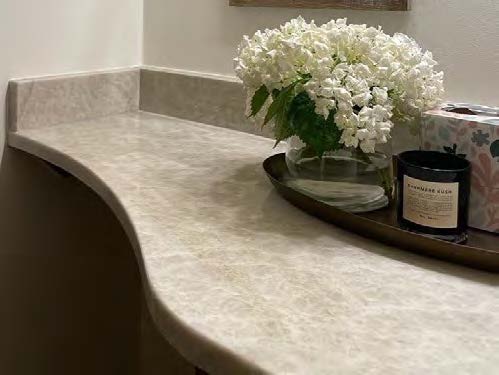
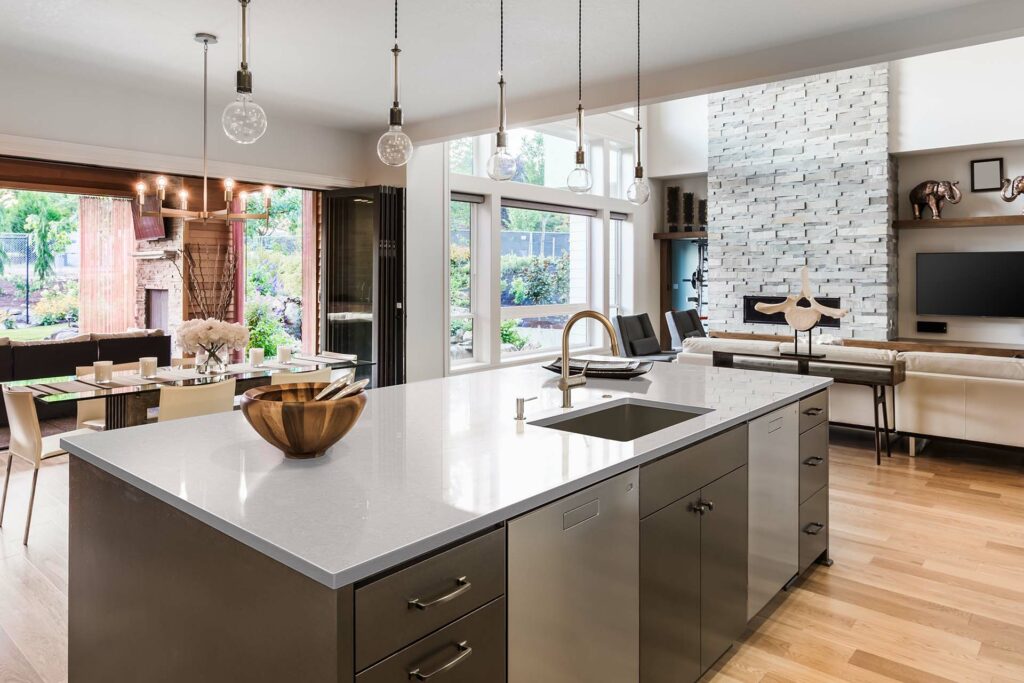
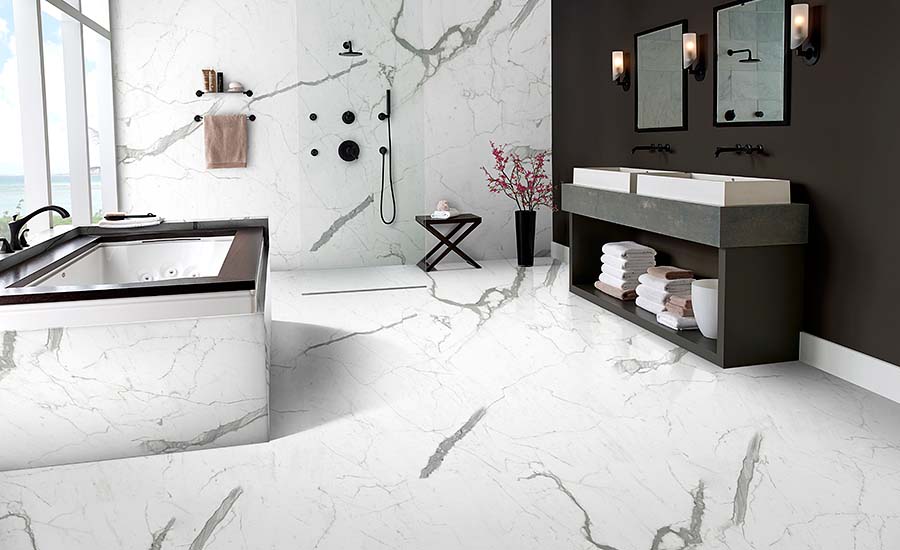
Before you ever set foot in the showroom, it helps to know what to expect. Here’s how we get you a ballpark number and start the conversation.
Get Ready for Your Consultation
To give you the best guidance, we’ll typically ask about:
Your project goals and objectives
The style or motif you’re after — modern, rustic, farmhouse and more
Whether you’re working with a contractor or designer
Whether new cabinets are part of the project
Whether you plan to reuse existing fixtures
Removal requirements for your existing countertops
Backsplash plans
A helpful rule of thumb for budgeting: countertops typically cost about 1–2% of your property value.
Get an Estimate
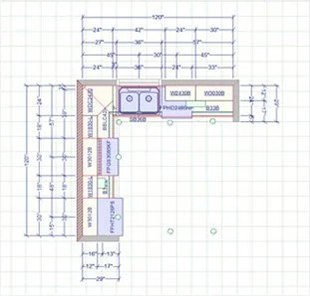
To put together an estimate, we’ll need:
Cabinet plans or a sketch, with measurements
Your contact details so we can send the estimate
Your material selection preferences
Sink selection
Backsplash specifications
This is an estimate only and may change based on final measurements, material selection, and edge choice.
Step 2 · The details
Step 2: Design Choices
This is where your countertop starts to take shape — edges, appliances, sinks, backsplash and more.
Edge Thickness
Most countertops are fabricated in 1.5cm, 2cm or 3cm thickness — your material and edge profile choice will help determine what works best for your project.
Front Edge Choices
Eased edge profile.
1/4-inch radius edge profile.
Pillow edge profile.
Overhangs & Tolerances
3cm natural stone: up to 10″ of overhang without support
3cm engineered stone: up to 15″ of overhang without support
Standard overhang is 1.5″ from the cabinet front and sides
Inconspicuous support brackets are available where needed
Appliances & Fixtures
Freestanding Ranges
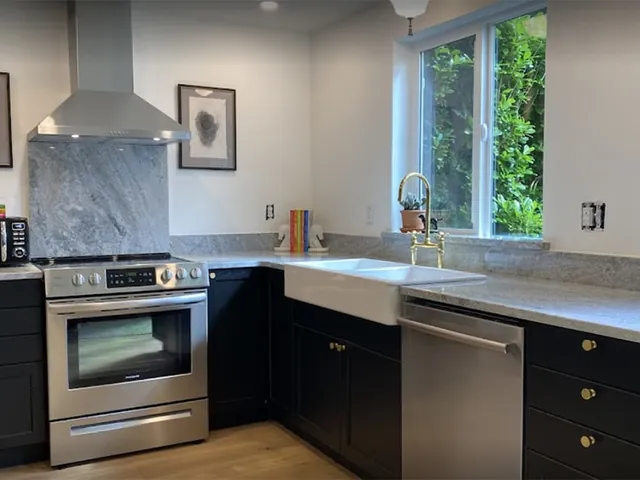
This is the most common type of range, which will have control panels on the back, generally have a 30″ opening, and the sides will be polished.
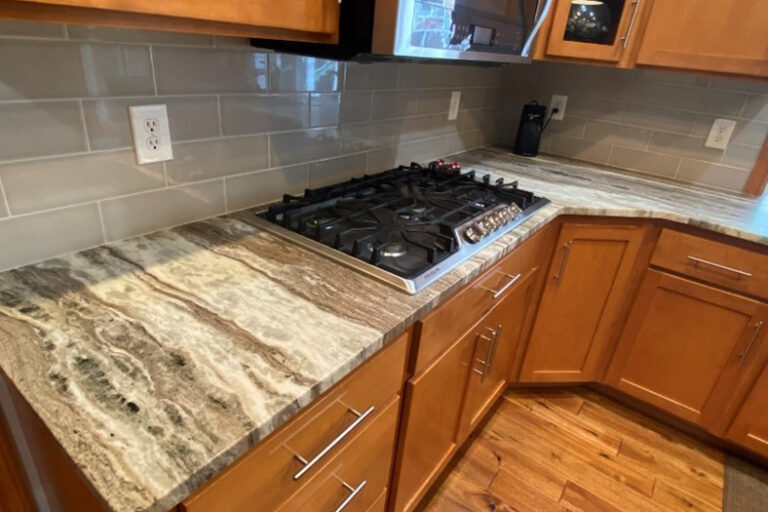
Slide-In Range or Cooktop
These require a “filler strip” behind the range, which comes at additional cost, and the appliance itself needs to be on-site at installation. A separate downdraft cutout incurs an additional charge.
Dishwashers
A metal bracket is added to span the standard 24″ opening.
Sinks
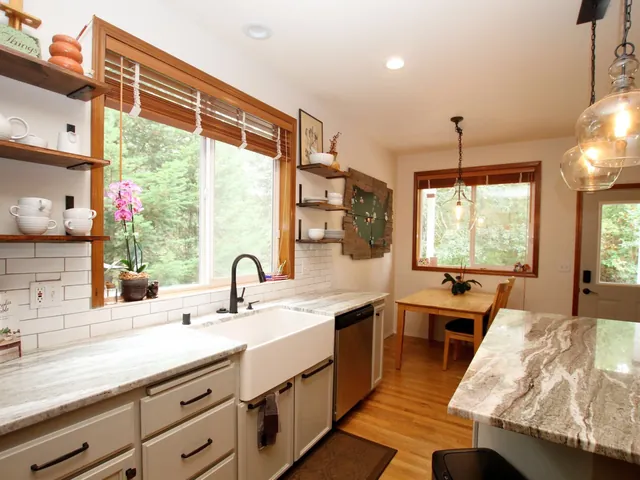
Tops offers a variety of high-quality sink options. If you’re providing your own sink, it must be new and in its original box, with the model number available, and on-site at template time. Farm sinks are positioned in the cabinet box with the top flush to the cabinet surface.
Sink Styles
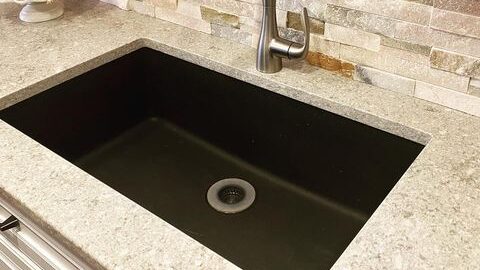
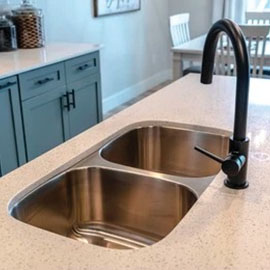
Under Mount
Most common. Mounted underneath the polished surface, set by Tops and reconnected by your plumber.
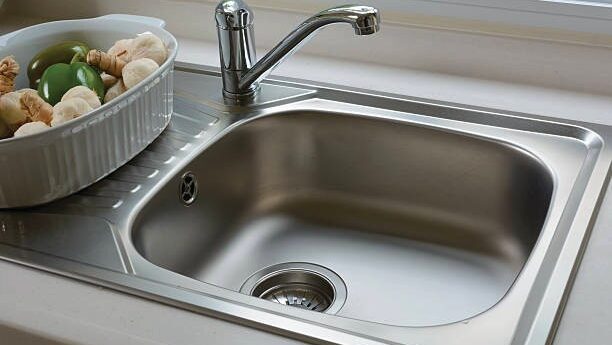
Top Mount
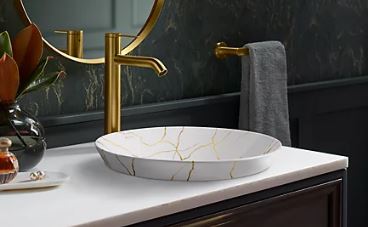
Sits on the counter surface. Set by the plumber.
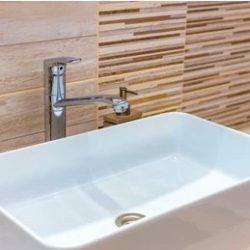
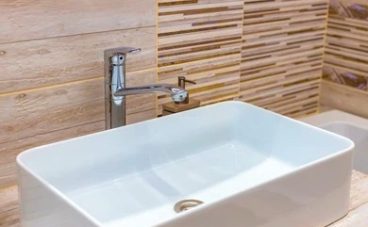
Vessel
Sits on top of the counter. Installed by the plumber.
Semi-Recessed
Halfway inset, halfway on top. Set by the plumber; additional fees apply.
Dual Mount sinks are top-mount only and cannot be undermounted.
Sink Materials
Stainless Steel
Typically 16-gauge. Durable, scratch-resistant and affordable.
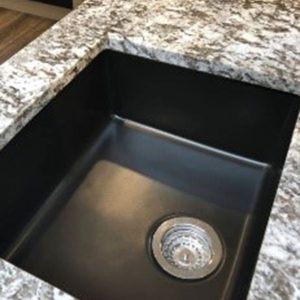
Granite Composite
Blanco Silgranit sinks in multiple models and colors. Mid-priced.
Porcelain
Includes porcelain-coated cast iron. Common with farm-style sinks.
Sink drain kits are sold separately. Faucets, drains and garbage disposals are also available through Tops.
Faucet & Faucet Holes
Standard faucet hole size is 1 3/8″
A single faucet hole is easier to keep clean
If you have a garbage disposal in an island, consider an air switch
Let us know if you’re planning a sprayer so we can plan the hole layout
Backsplash Options
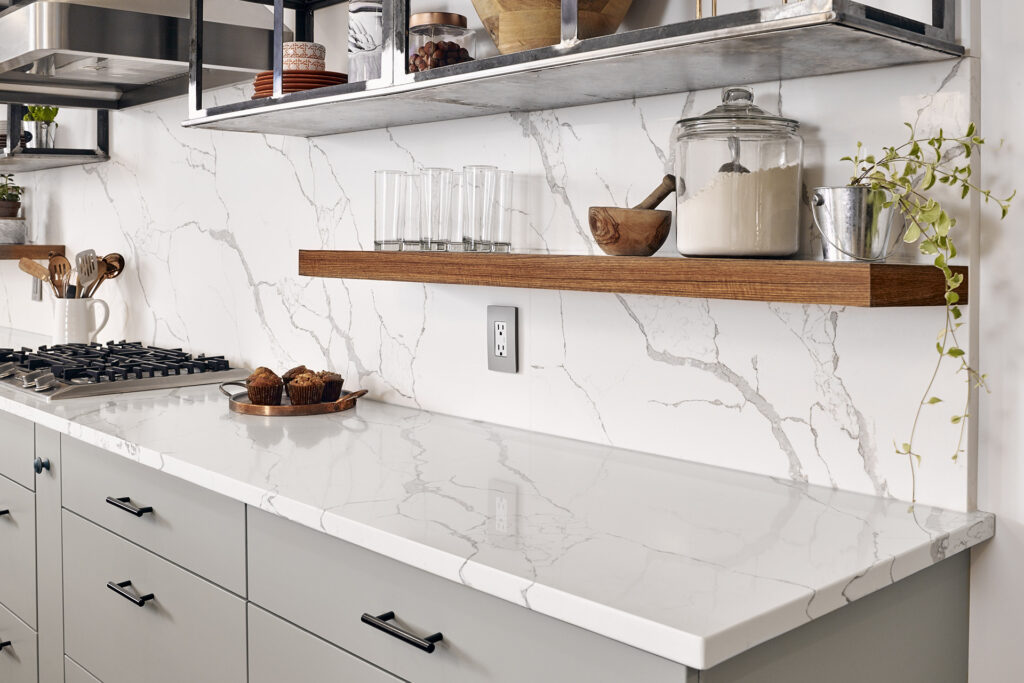
5-inch BacksplashFull-Height Backsplash
Cutouts & Pricing
Cutouts are discarded during fabrication
Projects are charged per square foot
Extra pieces should be specified before template and will be charged accordingly
Custom-order slabs typically include the full slab value
Plumbing & Electrical
We recommend a plumber disconnect fixtures before removal
Sinks require a 24-hour cure before reconnection
For full-height backsplash, outlets are removed and reinstalled by the customer
Outlet relocation is the customer’s responsibility prior to templating
Caulking
Undermount sinks, backsplash and counters are caulked during installation
White translucent caulk is typically used
Paintable caulk is used where stone meets sheetrock
100% silicone is used where stone meets stone or cabinets
You’re responsible for matching caulk to any existing backsplash
Caulking may shrink over time, or with house settling — regular maintenance is normal and expected.
Step 3 · The fun part
Step 3: Choosing Materials
General Color & Design Tips
Think “contrast, not compete” — darker materials complement lighter cabinets and vice versa
Avoid matching too exactly (white-on-white can read as flat)
A neutral light source matters for how bright the space feels
Consider a contrasting color for an island
Gather paint, cabinet and flooring samples before deciding
In-home design consultations are available for a fee
Color variation is expected, and an exact match to a small sample can’t be guaranteed.
Choosing a Material from a Sample
Types of Slab Materials
Natural Stone
Natural sedimentary rock of various types from quarries all over the world, sliced up and polished.
Granite
Marble & Soapstone
Quartzite
Man-Made / Engineered
Quartz — microscopic quartz pieces and stone bound with a polymeric or cement-based binder
Ultra-Compact Sintered Stone — including large-format porcelain slabs, Dekton, Neolith and Lapitec
Types of Material Finishes
Polished — the most common finish; easy to clean and maintain
Honed — a textured, unique finish, also called antique or brushed
Leathered — a matte finish that doesn’t reflect light; harder to maintain and shows fingerprints
Granite
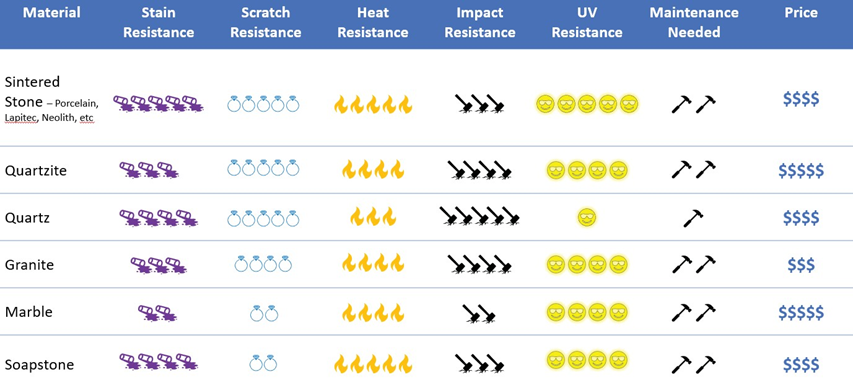
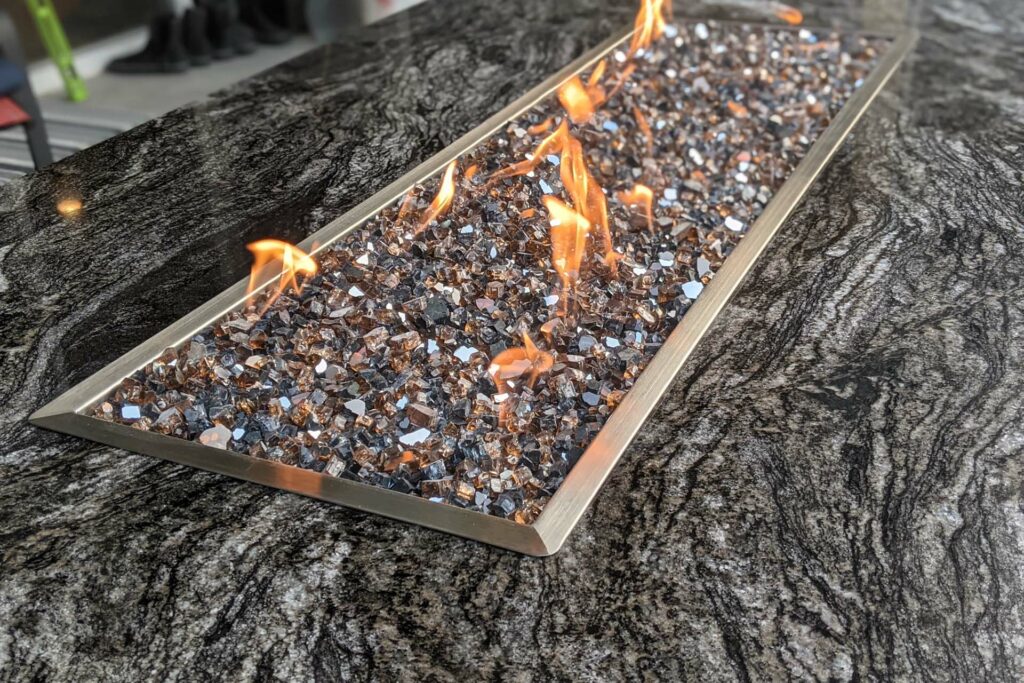
Granite is an extremely hard surface that’s very scratch resistant, and heat resistant enough for everyday cooking — though we still recommend a trivet or hot pad for hot pans, since thermal shock is possible with extreme temperature changes. It’s a great choice for outdoor applications and fireplaces.
Each stone is unique and subject to variation in background color, veining distribution and veining pattern. Fissures and pitting are naturally occurring features. We recommend using a cutting board rather than the granite itself, to preserve your knife edges.
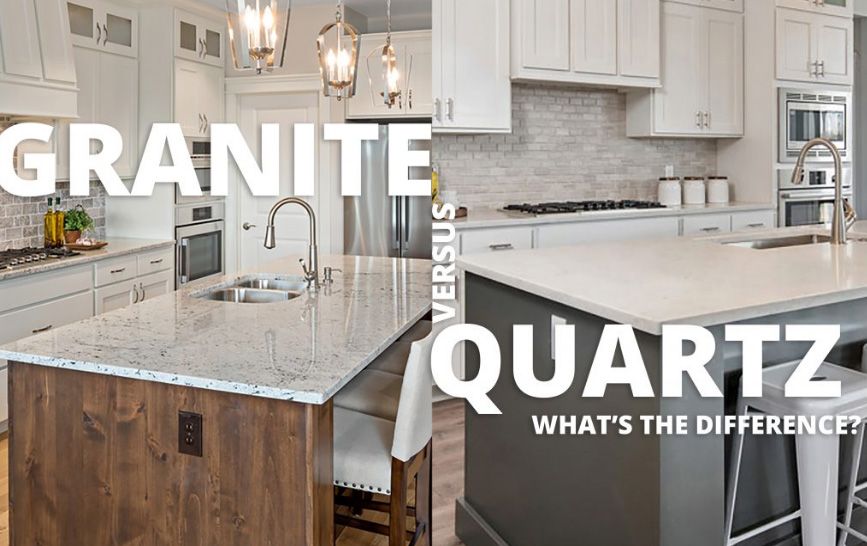
Granite vs. QuartzGranite Outdoor Fire Feature
Marble & Soapstone
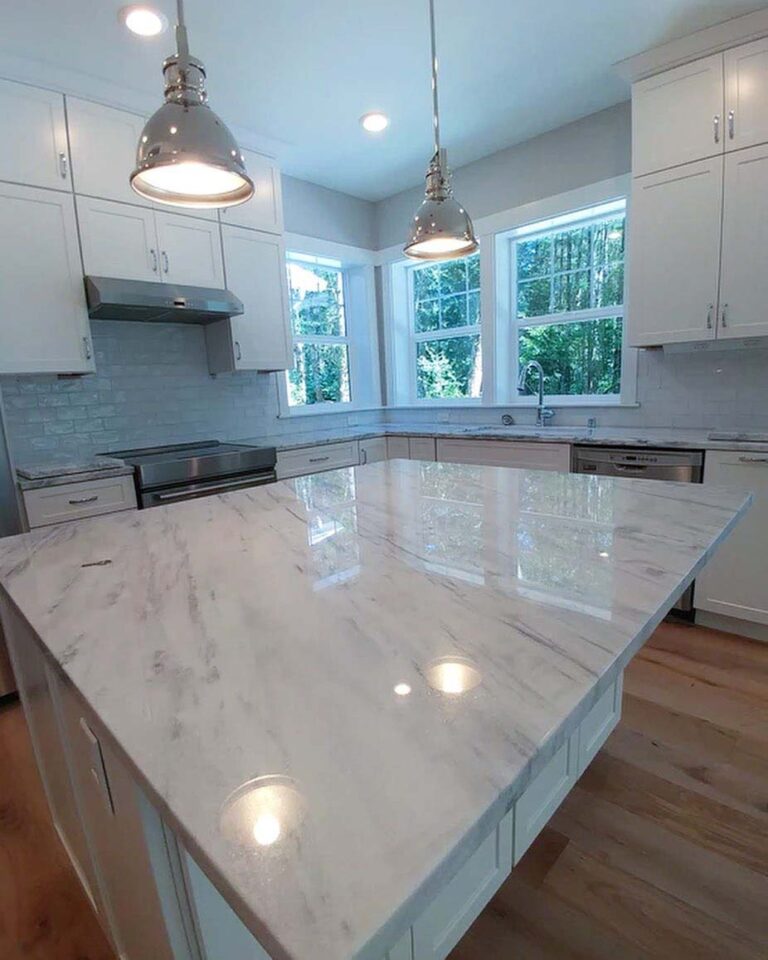
Both bring a unique color and appearance, and are great choices for backsplashes and low-traffic areas. They’re acceptable for kitchens too, though they carry a greater likelihood of staining and scratching than polished granite.
Quartzite
True quartzite is extremely hard — harder than most granites — and dense, which puts it toward the higher end of the pricing spectrum. We recommend hand-selecting any natural slab in person.
Quartz
Also called “engineered stone,” quartz has gained popularity thanks to improved, more vibrant color options, and it’s easier to clean than granite. It’s made from roughly 93% stone aggregates and 7% polyester resin by weight, so seams and shading variation can be more visible than on natural stone. Quartz isn’t UV stable and will fade with direct sunlight, so it’s not recommended outdoors, and it’s less heat resistant — a trivet or hot pad is recommended.
Ultra-Compact Sintered Stone
A fairly new product that’s gaining popularity fast, sintered stone offers a unique texture unavailable in natural or engineered stone. Produced through a sintering process, it has nearly 0% porosity and is resistant to acidic liquids, heat, staining and scratching, with low thermal expansion. That makes it a great fit for exterior and high-traffic applications — it’s extremely easy to maintain, though chips are extremely difficult to repair.
Layout Approval & Seams
Seam placement is at Tops’ discretion, per industry standards
Seams may vary 1/16″ to 1/8″ and can be visible
Shade variation is possible where pieces meet — more common with quartz
Multiple seams may be used depending on slab yield and availability
Wall-to-wall seams may be added when needed for restricted access, length, durability or cutouts
A slab layout appointment is available for a fee if you’d like to pre-approve exactly how your slab is laid out.
Step 4 · Locking it in
Step 4: Finalize Your Order
Once decisions are made, we ask for a signed proposal and 50% deposit (unless other terms have been set up in advance).
Your Project Timeline After Signing
We email you scheduling for template and installation dates
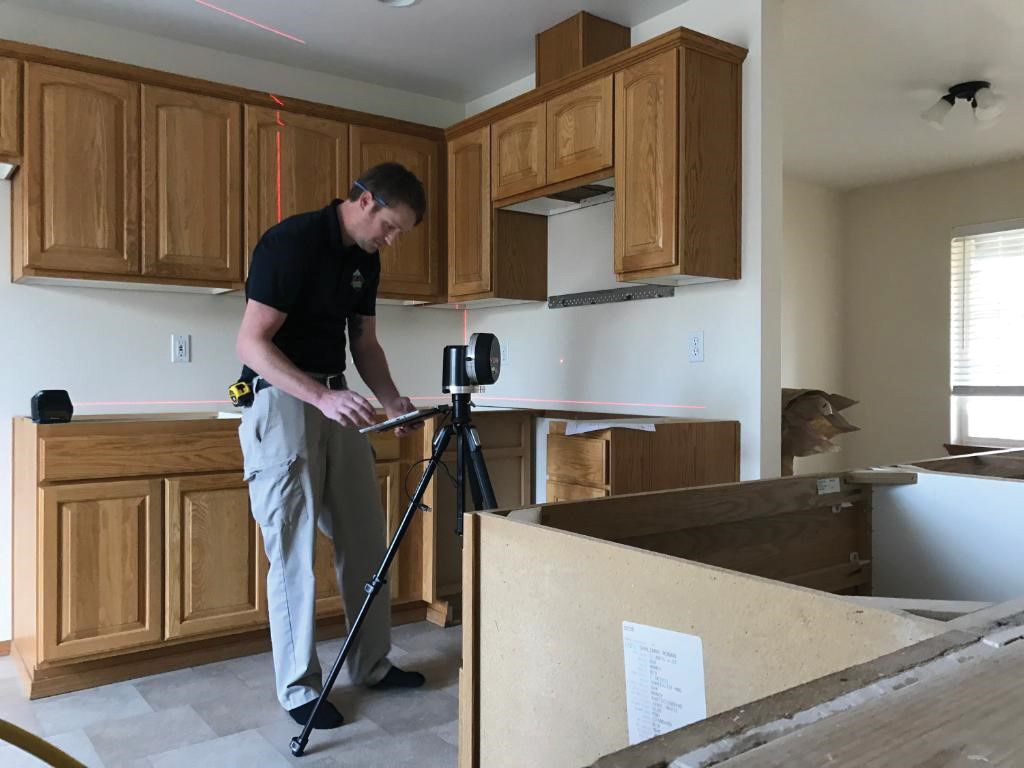
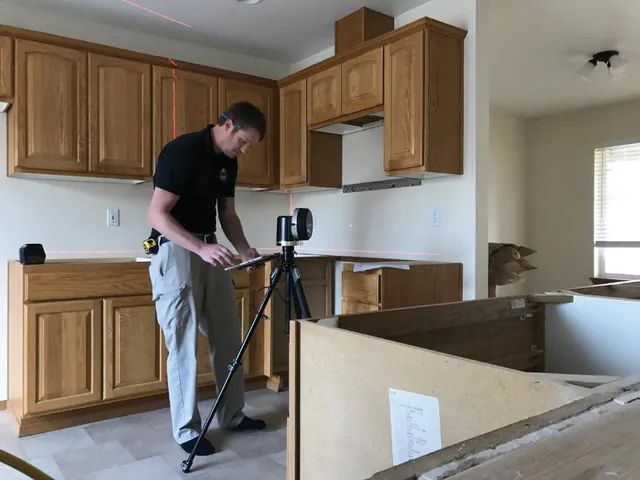
Laser template measurements are taken at your home
Price checks are completed and emailed after template
Your slabs are fabricated at our facility
Installation happens on your scheduled date
Touchups, remakes or tile backsplash install happen on a follow-up date if needed
Final payment is due upon completion (unless other terms exist)
Larger, more complex projects may be split into phase billings.
Step 5 · Measure twice
Step 5: Template
A Tops measure tech will come out and laser-template your space — here’s what we need on-site that day.
What We Need At The Project Site On Template Day
A clear kitchen or bathroom with no large obstructions
All items cleared from existing countertops, if we’re templating over them
The decisionmaker on-site to review final details
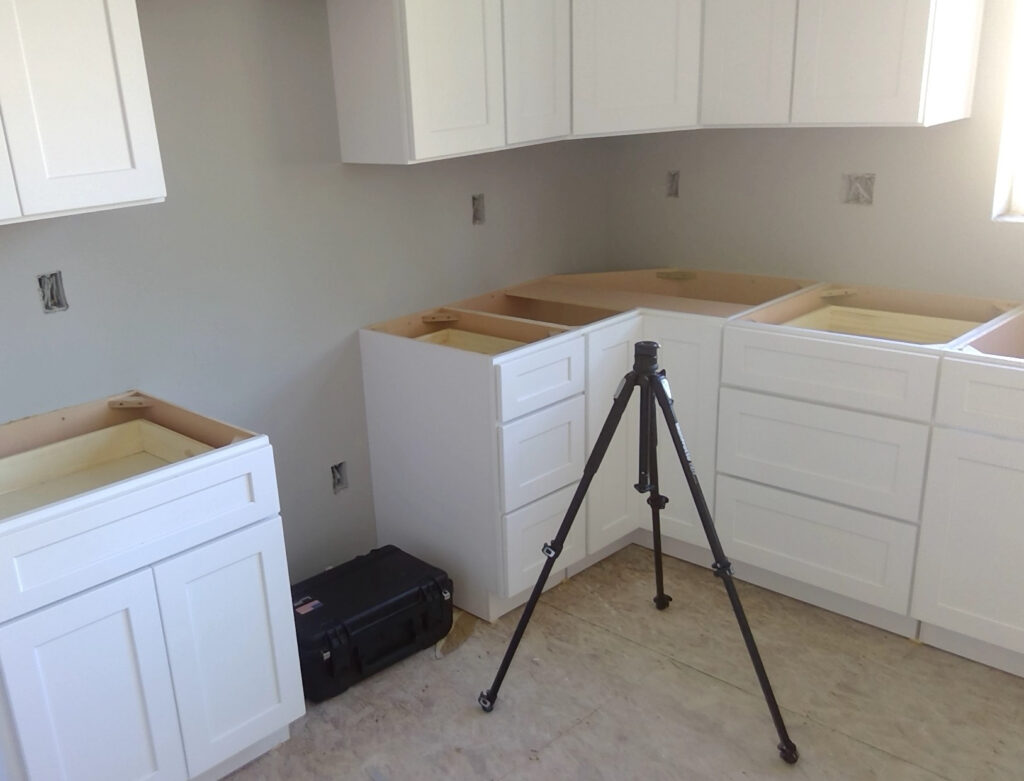
New cabinets permanently leveled and screwed to the wall, with finished end panels installed
Customer-provided sinks on-site, in original boxes, with model numbers
Farm sinks installed pre-template, with any cabinet modifications complete
Faucets and fixtures requiring holes on-site (or specifications available)
Stove or cooktop information on-site (or specifications available)
Templating On-SiteReady For Measure
Details Not Finalized at Template Delay Installation
The job isn’t ready for measure (cabinets not installed or secured)
Items are missing (sinks, cooktops, etc.)
The decisionmaker isn’t on-site
A return trip charge applies for items not on-site at template time, after-template changes, or additional requested trips for drilling holes that weren’t discussed up front.
Step 6 · The big day
Step 6: Installation Day
Normally, your installation will be completed in less than a day — even for projects that require removal of existing countertops.
Counters are ready for use as soon as our installers finish, though plumbing can’t be connected until the next day, and tile backsplash requires additional days on its own schedule.
Our Stone Technicians use a dye kit to color-match epoxy to your countertop, and the odor dissipates quickly.
What You Need To Do For Your Installation
Safety & Site Preparation
Clear a pathway to the installation area; remove loose rugs and dry any wet floor surfaces
Keep children and animals away from the work space
Schedule other trades — flooring, painting, plumbing, concrete — separately from install day
Occupants with respiratory issues should avoid the site on installation day
Open windows during installation to help with dust and odor
On occasion, stone may need to be cut, ground down, or polished on site, which creates a layer of dust.
Utilities & Fixtures
Allow a 24-hour cure before reconnecting utilities or installing fixtures
All plumbing, gas and electrical must be disconnected by the installation date
Tops mounts sinks and drills holes, but doesn’t connect plumbing — we’re happy to refer a licensed professional
During tear-out of existing counters and installation of new countertops, some unavoidable damage may occur to existing tile, backsplash, drywall, wallpaper or paint. These items are considered incidental damage.
Post-Installation
We’ll walk the finished space with you to confirm everything meets expectations.
Be sure to book a certified plumber to reconnect everything — you can find great plumbers through Olympia Master Builders or Pierce County Master Builders.
And please, tell us about your experience! Word-of-mouth referrals are the best way to support a local business.
Design before you commit
Visualizer Tools
Get a feel for your remodel — materials, colors and textures — with our free Kitchen and Bath visualizers, then visit our Lacey design center to see the real slab.

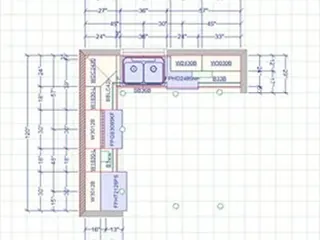
 To put together an estimate, we’ll need:
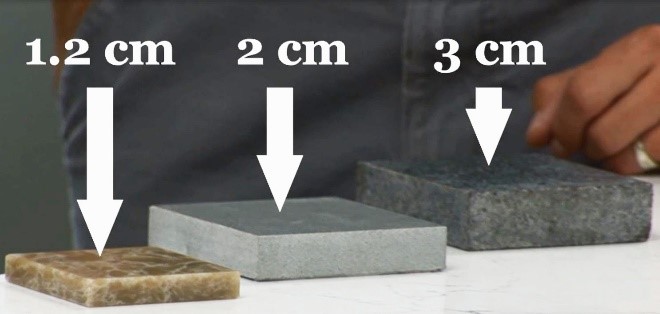 Most countertops are fabricated in 1.5cm, 2cm or 3cm thickness — your material and edge profile choice will help determine what works best for your project.