
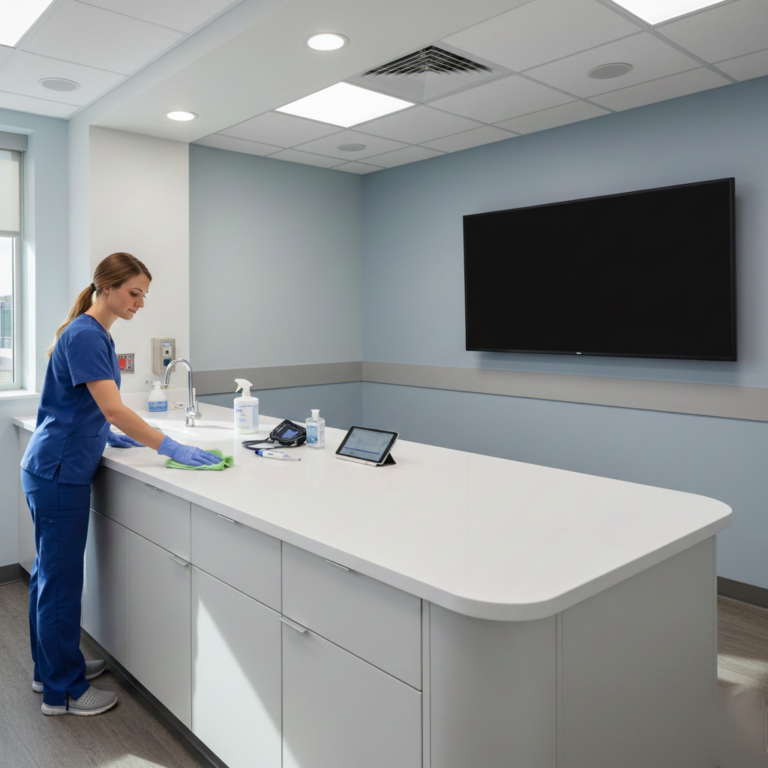
If you work in medical facilities, you already know that cleanability is everything. Healthcare environments depend on surfaces that stay hygienic through spills, disinfectants, and heavy daily use. Countertops that absorb moisture or trap microorganisms put patients and staff at real risk.
At Tops Countertops, we help facilities choose materials that support safer spaces. The right healthcare countertops must be:
- Non-porous
- Easy to clean and disinfect
- Built to withstand continuous wear
What Makes a Countertop Safe and Hygienic in a Healthcare Setting?
Cleanliness and cleanability are not a preference in healthcare. They’re requirements tied directly to patient safety and safety regulations. A countertop may look clean, but in a clinic or hospital, the real test is whether the surface can block bacteria, resist moisture, and hold up under constant disinfecting.
Why Non-Porous Materials Matter for Infection Control
Porous countertops absorb moisture and trap microscopic debris, even if the surface appears spotless. In a healthcare facility, that hidden moisture becomes a place where bacteria and mold settle and multiply. Non-porous surfaces stop this before it starts. They do not allow spills, disinfectants, or organic material to sink in. Instead, they stay on the surface where they can be fully wiped away.
This single property supports infection control more than almost anything else. A non-porous countertop limits the path bacteria can take from one patient to another. It reduces lingering contamination after spills. It gives staff confidence that one cleaning pass actually removes what is on the surface.
How Constant Cleaning Impacts Surface Materials
In a medical facility, countertops face disinfectants and cleaning agents all day long. Not every material is designed for this. Some finishes degrade slowly as chemicals strip away protective layers. That wear opens tiny scratches where bacteria settle, turning a once-hygienic surface into a problem.
Stronger materials stay stable through this cycle. They handle harsh chemicals without softening, losing finish, or developing rough patches. When countertops tolerate constant cleaning, staff can disinfect confidently without worrying about long-term damage or trapped debris.
Why Seamless Construction Is Critical in Medical Environments
Every seam is a hiding place. Moisture, organic material, and even small spills slide into gaps between pieces of material, along backsplashes, or around sink cutouts. Even with regular cleaning, these areas stay damp longer than the open surface, which creates ideal conditions for mold to form.
A seamless countertop removes those hiding spots. It eliminates joints where bacteria collect and closes off the tiny crevices where debris settles. In busy healthcare settings, seamless construction is not just a design choice. It is part of keeping the environment safer for patients and staff.
What Durability Looks Like in High-Traffic Medical Spaces
Durability and hygiene go hand in hand. Once a countertop scratches, dents, or wears down, bacteria find new places to settle. High-traffic healthcare areas put constant pressure on surfaces. Carts slide across edges. Equipment gets placed and moved. Staff clean the same spot dozens of times each day.
When a countertop material can withstand heavy use without breaking down, it stays hygienic longer. A scratch-resistant, stable surface maintains its cleanability through years of friction and chemical exposure. Picture a clinic counter cleaned hourly with abrasive wipes. A durable material still looks smooth months later. A weaker one loses its finish and begins to collect bacteria in tiny grooves.
Choosing the Right Easy-to-Clean Countertop Material for Healthcare Facilities
The materials that work best are the ones that stay non-porous or properly sealed, resist bacteria, and maintain their durability under stress. This section walks through the materials Tops Countertops offers and how each performs in clinics, hospitals, labs, and patient spaces.
Quartz Countertops: Reliable Cleanability in High-Traffic Spaces
Quartz is one of the most dependable options for healthcare facilities because it is naturally non-porous and resists bacteria without needing a sealer. It can handle strong disinfectants, constant wiping, and heavy daily use without losing its finish. This makes quartz a strong fit for patient rooms, check-in counters, high-touch nurse stations, and any area where hygiene cannot slip.
Quartz also stays stable under heavy workloads. It does not absorb moisture, does not harbor mold, and does not degrade the way laminate or softer materials can. Its durability and cleanability make quartz one of the most practical choices for modern medical facilities.
Porcelain Countertops: High Heat, High Chemical, and High Cleanability Performance
Porcelain is increasingly popular in healthcare environments because it handles almost anything a medical facility can throw at it. It resists harsh chemicals, heat, UV exposure, and constant disinfecting. It is non-porous, easy to clean, and prevents bacteria from settling into the surface.
Porcelain is especially valuable in areas where spills, chemicals, or extreme sanitation requirements are routine. That includes labs, procedure rooms, break rooms, and high-touch surfaces near sinks. Porcelain also offers a wide range of aesthetic options, which help create a calm, welcoming healthcare environment without sacrificing hygiene.
Granite: A Natural Stone That Performs Well With Proper Sealing
Granite is a durable natural stone, and with the right sealing schedule, it can work well in certain healthcare spaces. While it is not naturally non-porous like quartz or porcelain, a high-quality sealer protects the stone from moisture, spills, and bacteria. When sealed regularly, granite can handle disinfectants, daily cleanings, and the heavy use common in medical settings.
Granite tends to shine in areas where durability and aesthetics matter, such as reception counters, administrative areas, and patient-facing spaces. It can also work in lower-risk clinical environments when the maintenance schedule is respected.
A well-maintained granite surface supports healthcare hygiene because:
- Sealing limits moisture absorption
- Proper cleaning reduces bacteria formation
- Its hardness withstands high traffic and daily wear
Quartzite: Strong, Durable, and Resistant With Proper Care
Quartzite offers a unique balance for medical spaces. It is a natural stone harder than granite, which helps it hold up under heavy daily use. Like granite, quartzite requires sealing to remain hygienic, but once sealed properly, it becomes highly resistant to stains, spills, and bacteria.
Quartzite works well in spaces where a high-end, natural stone look is desired without compromising durability. It is often used in executive patient suites, waiting rooms, and administrative areas in medical facilities that value both performance and aesthetic appeal.
What Materials Healthcare Facilities Should Avoid
Even though Tops does not sell these alternatives, it is helpful to clarify what does not belong in a hygienic medical space.
Materials that create risks in healthcare environments include:
- Surfaces with grout lines, seams, or textured finishes that trap bacteria
- Countertops that degrade when exposed to disinfectants
- Materials that scratch easily, opening pockets for moisture and mold
These issues compromise infection control and make routine cleaning harder than it needs to be.
Matching Each Countertop Material to the Right Healthcare Space
Every area of a medical facility has different cleanability and durability expectations. Choosing the right surface helps create a safer, more comfortable environment for patients and staff.
- Patient rooms: Quartz or porcelain for a clean, low-maintenance surface
- Nurse stations and high-touch zones: Quartz for extreme durability and hygiene
- Labs or spaces with harsh chemicals: Porcelain for superior chemical resistance
- Lobbies, reception, and administrative areas: Quartzite or granite for durable, welcoming aesthetics
Each material plays a role that supports both infection control and patient experience.
Build a Safer, Cleaner Healthcare Environment With the Right Countertops
If your healthcare facility needs surfaces that truly support infection control, our team can help. We fabricate quartz, porcelain, granite, and quartzite for clinics, labs, patient rooms, and high-touch areas. Each material is evaluated for cleanability, durability, and long-term performance in medical environments.
Contact us today to review your plans and choose the safest, easiest-to-clean countertop options for your patients and staff.
FAQs: Quick, Clear Answers About Countertops in Healthcare Facilities
What makes a countertop material easy to clean in a healthcare setting?
Easy-to-clean medical countertops are non-porous, resistant to moisture, and able to withstand harsh disinfectants without degrading. In modern healthcare environments, the right surface materials prevent bacteria and mold from settling into scratches or seams. A hygienic countertop should wipe clean in one pass and stay smooth even after years of high-traffic use.
Are quartz countertops safe and hygienic for medical facilities?
Yes. Quartz countertops are non-porous and highly resistant to bacteria, which makes them a strong fit for clinics, patient rooms, and reception areas. Quartz also holds up well to disinfectants and constant cleaning, making it one of the best medical options for busy healthcare environments where durability and hygiene come first.
Why are solid surface countertops preferred for clinics and patient rooms?
Solid surface materials such as Corian® are popular in healthcare because they can be installed with seamless construction. This eliminates joints where bacteria collect. They are easy to repair, resistant to moisture, and cleanable with standard hospital-grade disinfectants. Even though Tops focuses on stone surfaces, solid surface countertops remain a proven commercial surface option in medical settings.
Can laminate countertops be used in healthcare environments?
Materials like laminate can work in certain administrative or low-touch areas, but they are not ideal for clinical spaces. Seams, edges, and the core material make laminate more vulnerable to moisture and bacteria compared to quartz or porcelain. Healthcare facilities require surfaces that do not swell, stain, or lose finish under heavy disinfecting, so laminate is best kept to cost-effective nonclinical zones.
Which countertop materials resist harsh chemicals the best?
Porcelain and epoxy resin are known for handling harsh chemicals without fading or softening. Quartz also performs well in most healthcare environments where strong disinfectants are used. These materials stay smooth and hygienic under constant cleaning, which is important for high-traffic areas that see frequent wipe-downs.
What is the most durable countertop for high-traffic healthcare areas?
Quartz and porcelain are among the most durable medical countertop options for high-traffic areas. They resist scratches, chemicals, and constant disinfecting without losing their surface integrity. In spaces that need both performance and a welcoming design aesthetic, these materials hold up to the test of time.
How can I choose the right countertop for my healthcare facility’s needs?
Choosing a countertop in healthcare starts with understanding how each space is used. Patient rooms benefit from warm, easy-to-care-for surfaces. Labs need high resistance to chemicals. Reception areas often look for durability paired with the look of natural stone. It is important to match the material to the function so the surface supports hygiene, efficiency, and overall design. Consulting a fabricator who understands modern healthcare demands helps you select the right countertop that lasts.