
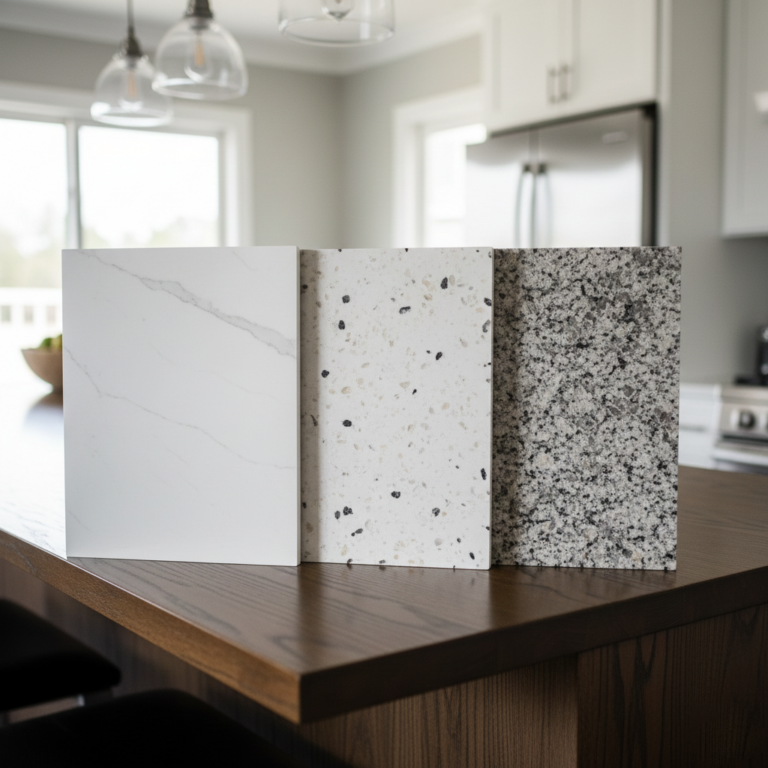
Homeowners often come in convinced that quartz countertops are always the low-maintenance choice or that granite is always the most durable. Porcelain countertops are now part of that conversation, and they shift the comparison completely.
As fabricators who handle full slabs every day, we see how each countertop material behaves in real kitchens and bathrooms. The biggest differences come down to:
- How porous or non-porous the surface is
- How it handles daily wear
- How it looks years later
How Porcelain, Quartz, and Granite Are Made: Why Structure Shapes Durability
Before comparing performance, it helps to understand how each material is built at its core. The structure of a countertop material decides how it handles heat, stains, scratches, UV exposure, and long-term wear. Once you see what goes into porcelain, quartz, and granite, the rest of the differences become much easier to understand.
Porcelain: High Heat and Pressure Create a Fully Non-Porous, UV-Resistant Surface
Porcelain slabs start as refined clay and mineral pigments that are pressed and fired at extremely high temperatures. This process vitrifies the material, locking everything into a dense, fully non-porous surface. That structure is why porcelain countertops resist stains, handle high heat, and stay stable under heavy use.
Because porcelain does not react to UV, it keeps its color even in bright spaces or outdoor kitchens. Homeowners who want a material that behaves the same indoors and out often gravitate toward porcelain for that reason.
Quartz: Natural Quartz Crystals and Resin Form a Hard, Low-Maintenance Surface
Quartz countertops combine natural quartz crystals with resins and pigment. That blend creates a dense, non-porous surface that stands up well to daily life without needing a sealer. The resins also allow quartz to offer consistent patterns and a wide range of colors that natural stone cannot always match.
The one thing to keep in mind is UV exposure. Strong sunlight can slowly discolor resins over time, which is why quartz does not perform as well outdoors as porcelain or granite. Indoors, though, quartz remains one of the easiest low-maintenance surfaces to live with.
Granite: A Natural Stone With One-of-a-Kind Movement and Natural Strength
Granite forms over millions of years, giving it unique veining and natural beauty that no engineered surface can replicate. Because it is a natural stone, granite starts porous, but sealing closes those pores and gives the surface strong protection against stains and daily moisture.
Once sealed, granite countertops are incredibly durable and handle heat better than most homeowners expect. Every slab is one of a kind, which is part of granite’s appeal for kitchens and bathrooms that need natural character rather than uniform patterns.
Why homeowners choose granite:
- It offers natural variation and movement
- It becomes highly durable once sealed
- It adds an organic, timeless look to the space
Why Structure Predicts Long-Term Performance
The way each material is built determines how it behaves years down the road. Porcelain’s fired structure gives it high heat resistance and UV stability. Quartz’s resin blend keeps it non-porous but sensitive to direct heat. Granite’s natural crystal structure provides strength, but it depends on proper sealing for stain resistance.
Imagine that a hot pan lands on each surface. Porcelain shrugs it off. Granite usually does fine, though caution is smart. Quartz reacts because resin is not designed for direct heat. Or consider a red wine spill left overnight. Porcelain and quartz stay clean. Granite stays clean when sealed, but absorbs moisture when neglected.
These small, everyday scenarios show how structure dictates long-term durability, wear and tear, scratch resistance, and stain behavior.
Porcelain vs Quartz vs Granite in Real Homes: Which Material Fits Your Lifestyle?
Once you understand how each material is made, the next question is how it behaves in an actual kitchen or bathroom.
Durability in Daily Use: Which Countertop Handles Wear and Tear Best
Durability shows up differently across these materials. Porcelain is highly resistant to scratches and handles heat without stress. It stays stable even in high-traffic kitchens. Quartz resists scratches well, too, but the resin inside it reacts to high heat. Granite holds up impressively once sealed, especially in homes where cooking is part of daily life.
In real homes, porcelain tends to shrug off wear and tear. Quartz handles most use confidently but needs protection from heat. Granite stands strong as long as its sealer is maintained.
Stain Resistance and Cleanability: How Each Surface Handles Spills
Porcelain and quartz are both non-porous, so spills stay on the surface. A quick wipe with soap and water takes care of most messes. Granite, once sealed, performs well too, though its stain resistance depends entirely on that sealing schedule.
Picture this: a cup of coffee tips over during a rush out the door. On porcelain and quartz, it dries on top of the surface and wipes clean hours later. On sealed granite, it clears with minimal effort. On unsealed granite, the liquid can settle into the stone, which is why sealing matters.
Heat Performance: Can You Set a Hot Pan Down Safely
Heat is where these surfaces separate clearly. Porcelain holds its strength under high temperatures and does not react to hot pans or cookware. Granite is naturally heat-resistant, though we still recommend caution to maintain a long-term finish. Quartz, though durable in many other ways, struggles with direct heat because resin does not handle high temperatures well.
The simplest rule: porcelain is carefree with heat, granite is dependable, and quartz prefers a trivet.
Outdoor Kitchens: Which Materials Hold Up Outside
Outdoor kitchens expose countertops to UV, moisture, temperature swings, and heavy use. Porcelain is the strongest option outdoors because it is UV-resistant and heat-tolerant. Granite also works well outside when the sealer is kept up. Quartz, on the other hand, is not designed for outdoor use because UV exposure can discolor the resins over time.
If the project involves sun, weather, or open-air cooking, porcelain is the first choice, and granite is a close second.
Aesthetic Differences: Natural Beauty vs Modern Consistency
Granite offers one-of-a-kind movement, natural veining, and the depth you can only get from a natural stone. Quartz gives you controlled consistency, clean patterns, and a wide variety of colors that support modern designs. Porcelain sits in the middle, giving homeowners the option to mimic natural stone, concrete, or marble without the upkeep that those materials sometimes require.
These differences matter when you want the surface to either stand out as a statement or blend into a sleek, minimal space.
Maintenance: What Each Countertop Needs Over Time
Porcelain requires very little maintenance. Quartz is low-maintenance, too, as long as homeowners protect it from direct heat. Granite asks for a bit more attention because it needs regular sealing, but once sealed properly, it becomes a reliable and durable surface.
Most homeowners choose based on how hands-on they want to be. Porcelain is closest to “install it and forget it.” Quartz is nearly as simple, with one heat-related caveat. Granite is rewarding if you are willing to reseal it when needed.
Cost and Long-Term Value: Which One Pays Off
The upfront price varies depending on the slab, brand, and thickness. Porcelain has gained popularity in recent years, and its long-term performance often justifies the investment. Quartz sits in the middle, offering strong value and predictability.
Granite can be cost-effective over time because a well-sealed slab stands the test of time while adding natural character to the home. The real value comes from choosing the material that matches your lifestyle, not the cheapest or the trendiest one.
Talk With a Fabricator Who Knows How These Materials Behave
Porcelain, quartz, and granite all offer something different, and the right choice depends on how you cook, clean, and use your kitchen or bathroom every day. Our fabricators work with these materials in real homes, not just displays. Come in and let us walk you through the pros and cons in person. Contact us today to get started.
FAQs: Quick, Clear Answers About Porcelain, Quartz, and Granite Countertops
What is the most durable countertop material for kitchens and bathrooms?
Porcelain is considered one of the most durable kitchen countertops because it is non-porous, heat-resistant, and highly scratch-resistant. Quartz is also very durable indoors and offers low maintenance. Granite is a natural stone that performs well, too, especially once sealed. The right choice depends on whether you prefer a natural look, like granite, or a material that requires minimal maintenance.
Is porcelain more heat-resistant than quartz and granite?
Yes. Porcelain countertops handle high temperatures easily because they are fired at extreme heat during fabrication. Granite is also heat-resistant, though we still recommend caution with pans directly on the surface. Quartz is the most sensitive because its resin can discolor or crack under high heat, which is why trivets matter.
Does granite need to be sealed regularly?
Yes. Granite is a natural stone, so it starts porous and needs sealing to stay protected from liquids and stains. With regular sealing, granite countertops hold up well in kitchens and bathrooms and stay easy to clean. Granite is also a popular choice for homeowners who want natural movement or a one-of-a-kind look.
Are quartz countertops low-maintenance in real use?
Quartz countertops are low-maintenance indoors because they are non-porous and resist stains. Cleaning usually takes nothing more than soap and water. Quartz is also consistent in color, which helps homeowners who want predictable patterns. The one thing to remember is heat. Unlike granite or porcelain, quartz can react to hot items, so using trivets is part of everyday care.
Can porcelain countertops chip or crack easily?
Porcelain is strong and highly resistant to scratches, but like any surface, an extremely heavy impact on an edge can chip it. Regular daily use rarely causes damage. Because porcelain is non-porous and fired at high temperatures, it stays stable even in high-traffic areas. Most homeowners choose it for its durability and minimal maintenance.
Which material is best for outdoor kitchens?
Porcelain is the top choice for outdoor kitchens because it is UV-resistant, heat-resistant, and non-porous. Granite is also a strong option outside if it is sealed regularly. Quartz is not recommended for outdoor use because UV exposure can discolor the resin. When comparing porcelain and granite for exterior spaces, porcelain is also more predictable in the long term.
What are the biggest differences between quartz and granite?
Granite is a natural stone with unique veining, color movement, and a natural look. Quartz is engineered, so it offers consistent patterns and a wide variety of colours and styles. Granite needs regular sealing because it is porous. Quartz does not require sealing and offers the low maintenance many homeowners prefer. If you are choosing between quartz and granite, the decision usually comes down to pattern consistency versus natural variation.
How do I choose between porcelain, quartz, and granite for my home?
Start with your lifestyle. If you want a non-porous surface that handles heat and outdoor use, porcelain is also a strong fit. If you want low-maintenance indoor surfaces with predictable patterns, quartz or granite alternatives are often appealing. If you love natural beauty and want a one-of-a-kind slab, granite or quartzite gives you that look. When selecting the perfect countertop, think about heat exposure, maintenance, style, and where the surface will be installed.