
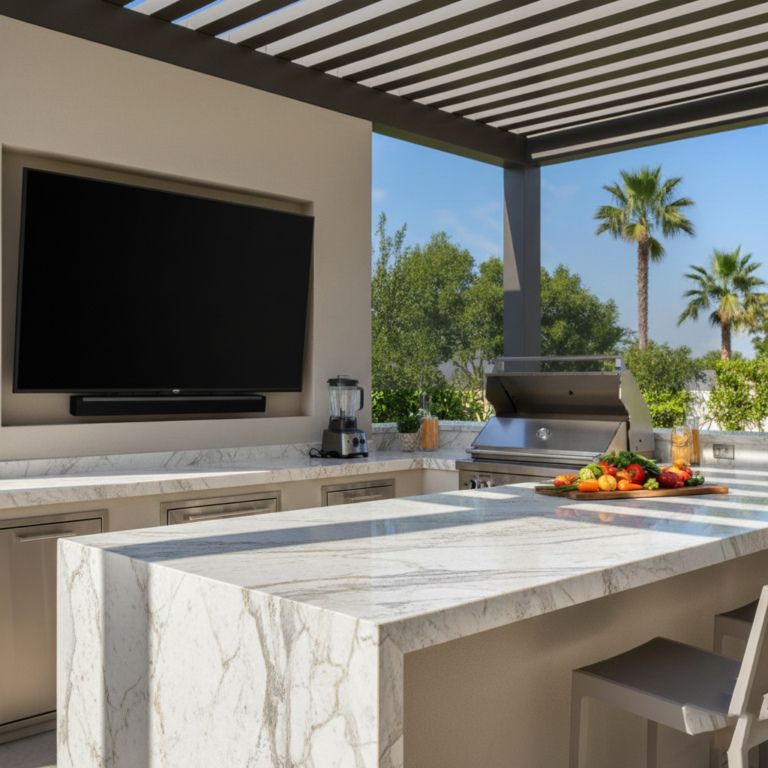
If you love the idea of quartzite countertops for an outdoor kitchen, you’re not alone. Homeowners are drawn to its natural beauty, marble-like veining, and impressive durability. Quartzite slabs hold up well outdoors, but like any natural stone, they have their own rules when they meet UV, rain, food spills, and everyday use.
As fabricators, we help homeowners understand what quartzite does well and where it needs support. Quartzite succeeds outside when:
- It’s sealed and maintained correctly
- UV and heat exposure are understood, not ignored
- The slab you select matches your outdoor layout
How Quartzite Performs Outdoors: The Real Pros and Cons
Quartzite has a reputation for strength, and for the most part, it earns it. But like any natural stone, it has specific behaviors outdoors that homeowners should understand before choosing it over granite, quartz, or porcelain. This section walks through those strengths and limitations in the same way we would during an actual slab-selection appointment.
Quartzite’s Biggest Strengths in an Outdoor Kitchen
Quartzite forms under extreme heat and pressure deep within the earth, which is why it ranks among the hardest natural stones available. That natural density allows quartzite countertops to handle high temperatures, outdoor cooking setups, and the occasional hot pan without stress. The surface stays resistant to scratches and everyday wear, even in homes where outdoor kitchens see heavy weekend use.
Beyond performance, homeowners choose quartzite for its natural beauty. Many quartzite slabs capture the soft veining and movement people love in marble but without marble’s fragility. When a homeowner wants a surface that feels organic, captures light beautifully, and still stands up to outdoor life, quartzite often checks those boxes.
How Quartzite Handles UV, Spills, and Everyday Outdoor Use
Quartzite performs better under UV exposure than engineered quartz, which contains resins that discolor in direct sunlight. This stability makes quartzite a reliable choice for uncovered patios and outdoor living spaces that get strong summer light.
Spills outdoors are different from spills indoors. Oils from grilling, acidic ingredients, and even rain can sit longer on the surface. Quartzite can handle a lot, but certain acidic liquids may still leave subtle marks if left for too long. Imagine a homeowner making drinks during a barbecue and leaving a citrus-filled glass on the counter overnight. In most cases, quartzite shrugs off the spill, but repeated exposure to acids can lead to faint etching over time.
The Limitations: What Quartzite Still Needs Outdoors
Quartzite performs well outside, but it is not a zero-maintenance material. These are the limitations that matter when you place natural stone in an outdoor kitchen.
Key limitations to understand:
- Quartzite is still porous enough to stain if left unsealed: Even though it is less porous than marble, liquids can still settle into the surface over time. Without a sealer, oils, wine, and greasy barbecue spills can leave dark patches in the stone.
- Harsh cleaners break down the sealer faster: Many outdoor cleaners contain strong chemicals that strip sealing products. Once the sealer weakens, the stone absorbs more than homeowners expect, especially after messy cookouts or rainy weeks.
- Not all quartzite slabs are equally dense: Some come out of the quarry extremely hard and compact. Others have softer pockets that behave differently under outdoor wear. Two slabs with the same name can perform differently, which is why working with an experienced fabricator matters.
- Quartzite requires consistent maintenance outdoors: Sun, rain, heat, and daily cooking all wear the surface faster than they would indoors. Proper sealing and gentle cleaners are part of keeping quartzite stable long-term.
Each of these points shapes how well quartzite performs outside, and together they help homeowners set smart expectations before choosing it for an outdoor kitchen.
Quartzite vs Granite vs Quartz for Outdoor Applications
Quartzite and granite are both natural stones, and both perform well outdoors. Granite tends to be slightly more porous, but it stays stable and predictable with regular sealing. Quartzite is harder, more resistant to scratches, and often offers that marble-like look without the high maintenance.
Quartz, on the other hand, is engineered with resins that react negatively to UV exposure. Outdoors, quartz can fade, yellow, or warp over time, which is why we steer homeowners toward natural stone or porcelain for exterior projects.
Compared to marble, quartzite is in another league. It delivers the beauty of marble with far better resistance to heat, stains, and daily outdoor exposure.
When Quartzite Is the Best Outdoor Countertop Choice
Quartzite shines in outdoor areas where heat, sunlight, and frequent use are unavoidable. Grill islands, sunny patios, and backyard kitchens that see a lot of action are the spaces where quartzite will perform its best. It holds its color and surface strength long term, especially when sealed properly.
Homeowners who want soft whites, grays, or marble-like movement often end up choosing quartzite because it blends durability with refined veining. When the goal is a natural surface that elevates the outdoor design without constant maintenance, quartzite is often the right call.
Deciding If Quartzite Fits Your Outdoor Kitchen: Practical Guidance
Choosing quartzite for an outdoor kitchen isn’t just about liking the look of the slab. It’s about understanding how it behaves outside, how it ages, and whether the upkeep fits your lifestyle.
What You Should Expect From Quartzite Over Time
Outdoors, quartzite changes in subtle but predictable ways. The surface can develop a soft evolution in texture as it weathers sunlight, rain, and everyday wear and tear. This isn’t deterioration. It’s the natural settling of a stone that has been through millions of years of pressure before it ever reached your backyard.
Even with seasonal temperature swings, quartzite stays structurally stable. It doesn’t warp, shift, or weaken the way engineered materials might when exposed to constant UV. Homeowners who appreciate natural stone usually see this gradual change as part of the stone’s character rather than a flaw.
How to Maintain Quartzite in an Outdoor Environment
Care habits that help quartzite stay protected:
- Clean spills quickly, especially acidic liquids.
- Reseal the countertop as recommended to maintain stain resistance.
- Use gentle cleaners instead of harsh chemicals that strip the sealer.
These habits keep the sealer intact and prevent staining or long-term dulling. Outdoor stone faces more than just kitchen messes. Weather, pollen, grill grease, and UV all play a role. With proper care, quartzite keeps its strength and surface quality far longer than most homeowners expect.
What Quartzite Costs Compared to Granite and Quartz
Quartzite often sits at a higher price point than granite or quartz because it is harder and takes more time and specialized tooling to cut, shape, and polish. That extra fabrication effort comes from its density and natural structure.
Homeowners still choose quartzite because the performance matches the investment. It offers long-term durability, a natural beauty you cannot replicate with engineered surfaces, and a strength that supports heavy outdoor use. When you compare quartzite slabs side by side with granite and quartz, it becomes clear why it often outperforms them outdoors.
When Quartzite May Not Be the Right Choice
Quartzite may not be ideal for homeowners who want a surface that stays completely uniform or requires zero maintenance. It also might not be the best fit for those who want a predictable pattern with no natural variation.
In those cases, porcelain offers a low-maintenance alternative, especially for outdoor kitchens. Granite provides a more cost-effective natural stone option with strong outdoor performance. The goal is to help you decide which countertop material fits your expectations so your outdoor space works the way you want it to.
See Quartzite Slabs in Person Before You Decide
Outdoor kitchens demand the right material, and quartzite deserves to be seen up close. Visit our Design Center to compare full slabs in natural light and get a clear sense of veining, color movement, and finish. Our team will help you understand how quartzite, granite, and porcelain each perform outdoors so you can choose the best fit for your space.
FAQs: Quick, Clear Answers About Quartzite for Outdoor Kitchens
Is quartzite good for outdoor kitchen countertops?
Yes. Quartzite countertops are an excellent option for your outdoor kitchen because quartzite is a natural stone formed from quartz sandstone under intense heat and pressure. This makes it one of the hardest natural stones available. It handles outdoor conditions, looks beautiful in soft whites and grays, and holds up against general wear and tear better than many alternatives.
Does quartzite fade in the sun?
Quartzite does not fade the way quartz can because quartz is engineered with resins that react to UV exposure. Quartzite is a metamorphic rock, so it remains stable in sunlight and keeps its colors and patterns outdoors. This is one reason homeowners considering quartzite choose it as a reliable choice for outdoor kitchens.
How often should quartzite be sealed outdoors?
Quartzite is less porous than many natural stone countertops, but outdoor use exposes the surface to rain, food spills, and heat changes. Most outdoor quartzite countertops benefit from sealing once a year. This helps protect against stains and keeps the surface performing well long term.
Can quartzite resist stains and acidic spills?
Quartzite is highly resistant to stains, but like many natural stone materials, acidic liquids can leave subtle marks if they sit too long. Think citrus, wine, or marinades left out during a cookout. Quick cleanup limits etching, and a good sealer keeps quartzite from absorbing spills.
Is quartzite more durable than granite outdoors?
Quartzite is generally harder than granite and often more resistant to scratches. Both are strong outdoor countertop materials, but quartzite offers extra durability along with the beauty of marble-like veining. Granite still performs very well outside, but quartzite gives homeowners who love natural stone a slightly stronger option.
Does quartzite handle heat from grills and hot pans?
Yes. Quartzite can handle high temperatures and hot pots and pans better than most countertop materials because it was formed under extreme heat and pressure. Still, using a trivet protects both the stone and the sealer from sudden temperature shock.
How does quartzite compare to quartz for outdoor use?
Quartzite is the better outdoor performer. Quartz is engineered with resins that can discolor or weaken in UV light. Quartzite holds its strength, color, and natural beauty outside, making it the safer choice for outdoor countertops. Indoors, both work well, but for an outdoor kitchen, quartzite is the clear winner.
What should homeowners know before choosing quartzite for outdoor spaces?
Quartzite offers durability, strength, and the look of marble without marble’s fragility. It’s a natural stone that is durable and resistant to scratches and heat. Just remember that quartzite requires sealing and gentle care outdoors. For homeowners who love natural movement and the beauty of quartzite and want a surface that stands up to outdoor use, quartzite is one of the best options available.